



From November 27 to 30, 2025, Pope Leo XIV visited Turkey and then traveled on to Lebanon. I had the opportunity to participate in the Turkish part of his trip. I will not report on the Pope’s meetings or comment on his speeches, statements, or homilies: as all these can be found in many publications elsewhere. Instead, I would like to offer my reflection from a Franciscan point of view.
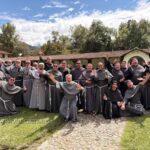
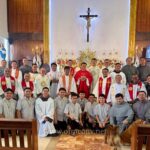
First, the Conventual Franciscans have three communities in Turkey: two in Istanbul and one in Izmir. Moreover, the Most Reverend Martin KMETEC, Archbishop of Izmir, is a Conventual Franciscan. Thus, the Conventual Franciscans were deeply involved and highly visible during the religious events that took place during the Pope’s visit. The friars participated in the organizational and logistical work, in the amazing liturgical events and gave wonderful witness of their presence. One of the cardinals even joked (paraphrasing): “Everywhere you look there are Conventuals! It’s wonderful!” I don’t want to list the name of every friar and the role he played in case I leave someone out. Let me give you an important detail regarding the liturgy: the altar on which Pope Leo XIV celebrated Mass on Saturday, November 29, came from our Church of the Nativity of the B.V.M. in Büyükdere.
Second, one of the topics the Pope addressed, especially during his visit to the Cathedral of the Holy Spirit in Istanbul, was the idea of being a minority. In a certain sense, this may be linked to the Franciscan idea of minoritas. One of the Pope’s phrases remains particularly impressed on my memory: “When we look with God’s eyes, we discover that he has chosen the way of littleness.” Quoting the evangelist Luke, the Pontiff said: “Do not be afraid, little flock, for it is your Father’s good pleasure to give you the kingdom” (Lk 12:32). Pope Leo XIV affirmed that the “logic of littleness is the Church’s true strength.” This is exactly the work our confreres do in Turkey.
Third, when speaking about Christian dialogue—especially in the context of diversity (sensibility, spirituality, culture)—one could clearly read the Pope’s invitation to humility, which he addressed to all parties who engage in this dialogue. This is also a typically Franciscan characteristic. Allow me a brief historical note that constitutes an interesting lesson in humility, or the lack thereof. The city of Istanbul—formerly Byzantium, then Constantinople—is a place of extreme change and one of the most important centers of Christian development. In 330, Emperor Constantine chose it as his capital, which later became the capital of the Roman Empire. In 395, under Theodosius, Constantinople was already the capital of the Byzantine Empire, when Christianity had become the state religion. In 1204, the city was sacked by crusaders (4th Crusade), who established the Latin Empire. However, in 1453, the Muslims entered Constantinople. Did Mehmed II, called “the Conqueror,” already know that he would bring an end to the powerful Christian empire?
Here’s an interesting observation: there were no signs announcing the Pope’s visit on any street in Istanbul, apart from our Church of St. Anthony and the Catholic cathedral.
What an instructive lesson for us Christians: it is not political greatness that guarantees survival or spiritual growth; but faithfulness and trust in God—and that requires humility.
That is why, at present, ecumenical dialogue is the only viable option for religious dialogue in Turkey. Unfortunately, even this dialogue is burdened by historical events in which force was often used. There can be no dialogue between “winners” and “losers,” as has often been the case in relations between the Christian East and West. Dialogue is possible only on equal footing. According to Pope Leo XIV, such equality in Turkey can be found in a shared profession of faith, prayer, and the sacraments. In relations with Muslims, however, positive models of coexistence still need to be built.
Our confreres—the “little flock”—work in a difficult environment, so let us recommend them all the more to our prayers, our goodwill, and our fraternal solidarity. I would like to personally express my deep gratitude to our confreres in Turkey, for allowing me to experience these events, make new contacts, and open myself to certain future projects.
Friar Sławomir KLEIN, Delegate General for Ecumenism and Interreligious Dialogue (EDI)