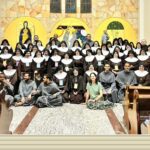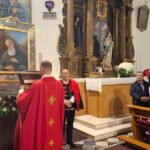




On March 11, 2026, a group of thirteen European Union ambassadors to the Holy See, accompanied by two secretaries, visited Assisi to pay homage to the mortal remains of St. Francis. After a greeting from the Custos of the Sacred Convent, Friar Marco MORONI, everyone proceeded to the basilica, where each participant paused for a moment, in silence, before the reliquary containing the remains of St. Francis.
After a brief visit to the friary portico—which greatly impressed the guests, the second half of the visit took place at the headquarters of the International Center for Ecumenism and Interreligious Dialogue (CEFID), located at the Franciscanum study center in Assisi. The main purpose of the visit there was to commemorate the 40th anniversary of the 1986 prayer meeting of religious leaders convened in Assisi by St. John Paul II. After the visitors recited a prayer for peace in the Franciscanum chapel, I spoke to them about the spirituality of the Spirit of Assisi and its Franciscan dimension. Next, the “Spirit of Assisi Lamp” was presented to the ambassadors. It will be placed in the chapel of the Italian embassy. Another prayer meeting in the Spirit of Assisi will soon be taking place there. Some may feel that linking the religious Spirit of Assisi project with politics is inappropriate. Naturally, the relationship between politics and religion has been a highly controversial issue since the dawn of human history. In many countries, however, politics supports the ideals of interreligious dialogue and ecumenism, while in others it remains a challenge. Let me recount the story of St. Francis’ visit to the sultan in 1219. Beyond the religious and spiritual dimension of his mission, one cannot overlook its political consequences. About ten years later, when al-Malik al-Kamil decided to return Jerusalem to the Christians, it was likely the result of a political settlement made with Emperor Frederick II, in a context shaped by Frederick’s conflict with John of Brienne (King of Jerusalem from 1210 to 1212, Latin Emperor from 1231 to 1237). In my view, beyond politics, the sultan’s experience with St. Francis was decisive. It may come as a surprise, but John of Brienne later entered the Franciscan Order.
Putting aside any political speculation about why the ambassadors to the Holy See were in Assisi, I saw their visit as an encounter between people willing to engage in dialogue. Moreover, many politicians are people of faith. For them, interreligious and ecumenical dialogue is not just work, but a mission.
Friar Sławomir KLEIN
General Delegate for Ecumenism and Interreligious Dialogue (EDI)