


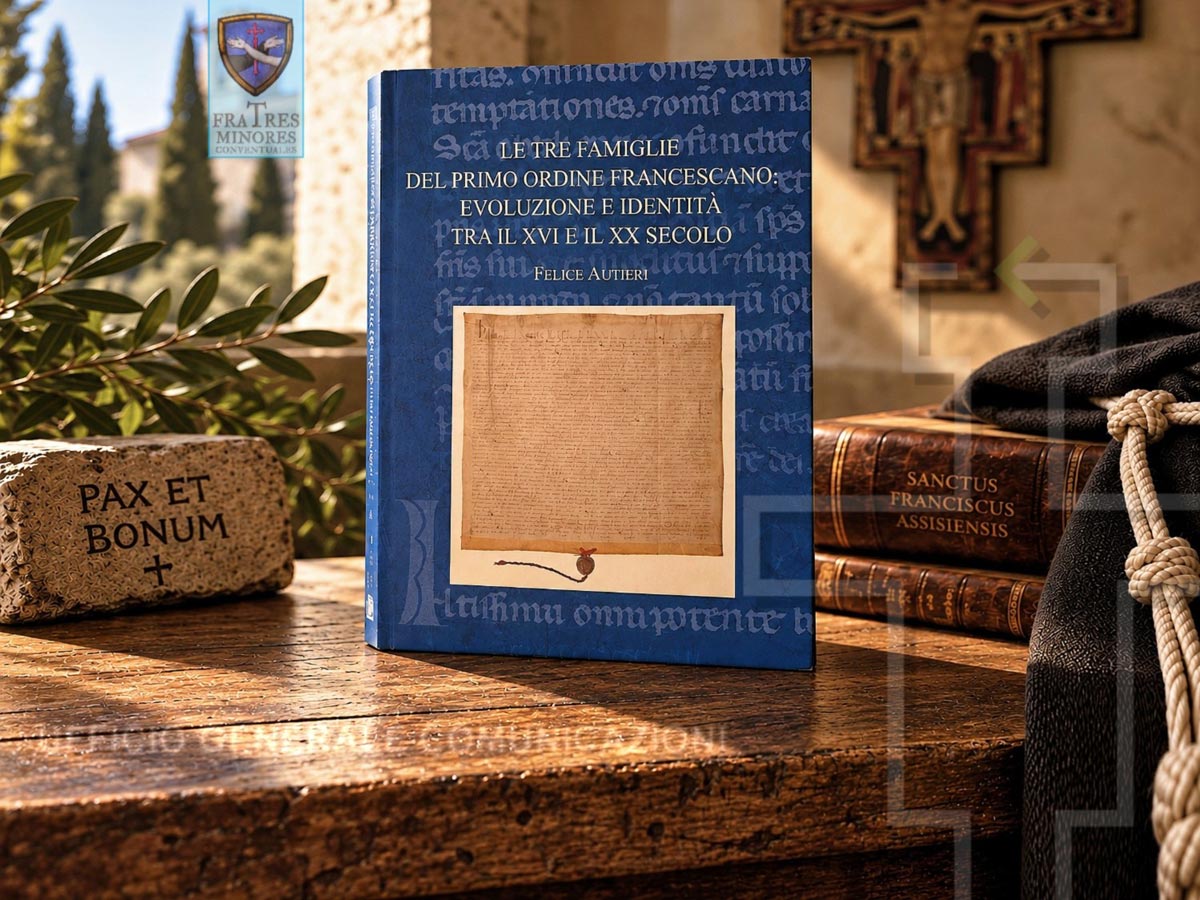
The journal Studi Francescani has published a book by Friar Felice AUTIERI titled The Three Families of the Franciscan First Order: Evolution and Identity from the 16th to the 20th Century.
The book offers a comparative study of the history, reforms, culture, and organization of the Friars Minor, Friars Minor Conventual, and Friars Minor Capuchin, beginning with the papal bull Ite vos of 1517.
The author traces the major developments in the history of the three families within the broader context of European and Church history, beginning with the internal reforms of the 16th century and continuing with the suppression of small friaries ordered by Innocent X; the jurisdictionalism and regalism of the 18th century; the consequences of the French Revolution; the suppressions of the 19th century; the unification of the Friars Minor under the 1897 papal bull Felicitate quadam; and, finally, the implementation of the reforms of the Second Vatican Council and more recent developments.
The book devotes ample space to the various reforms and movements that emerged over the centuries: the Reformed, Amadeans, Clareni, Alcantarines, and Recollects among the Friars Minor; the Reformed Conventuals and Pasqualites among the Conventuals; various movements associated with the Capuchin tradition; and several more recent Franciscan communities.
The book also explores the institutional and juridical structures of the three families, focusing on the role of the Minister General, the Chapters, the Curias, the Procurators, and the Guardians of the friaries. It also examines the Custody of the Holy Land held by the Friars Minor. Furthermore, it examines the evolution of the Constitutions and other legislative sources, up to the post-conciliar reforms and contemporary legislation, including the 2019 Constitutions of the Friars Minor Conventual.
Other topics include the evolution of the Franciscan habit, the missionary dimension of the families, and the network of colleges established to educate friars and prepare them for service in different parts of the world, namely, the Americas, the Holy Land, Asia, Africa, and Oceania.
A substantial portion of the book examines the culture and scholarship fostered by the Franciscan First Order and its contribution to theology, philosophy, Sacred Scripture, history, liturgy, music, the sciences, the humanities, the visual arts, and law. In this context, the author also discusses the development of the Ratio studiorum and the establishment of major Franciscan academic centers, including the Pontifical University Antonianum and the Pontifical Theological Faculty of St. Bonaventure.
Finally, the book looks at the social and pastoral dimensions of Franciscan ministry, service to the Holy See, and various forms of Franciscan presence in society. The book concludes with an examination of the worship and devotional practices that developed within the three families, particularly Christological and Marian devotion, devotion to St. Francis and St. Joseph, and devotion to all the saints and blesseds who have shaped the spiritual history of the three families.
Editorial Staff