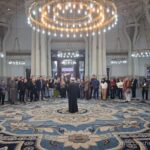




On June 14, 2025, in Harmęże and Auschwitz, Poland, a ceremony took place to commemorate the first 728 Poles transported by the Nazi Germans to the Auschwitz concentration camp eighty-five years ago.
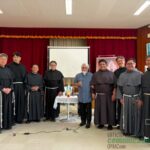
Those attending the ceremony included ten Auschwitz survivors, the management of the Auschwitz-Birkenau State Museum, representatives of the Franciscan and Salesian Orders, members of the diocesan clergy, delegates of the President of the Republic of Poland, the diplomatic corps, state and local authorities, the Roma community, various national institutions, associations, foundations, social organizations, and individual citizens who wished to pay tribute to the victims of Nazism.
At the St. Maximilian Center in Harmęże, the Most Reverend Roman PINDEL, Bishop of Bielsko-Żywiec, Poland, presided over a Mass celebrated in suffrage for the prisoners of the first transport. The victims included soldiers from the September campaign (Polish soldiers who fought during the German invasion of Poland, which began on September 1, 1939, an event that marked the start of World War II), members of clandestine independence organizations, high school and university students, as well as Polish Jews. In his homily, Bishop PINDEL reflected on the well-known motto “Arbeit macht frei” (work sets you free) placed at the gates of the camp, calling it a cynical distortion of the Gospel: “Dear brothers and sisters, today we reflect on the meaning of the phrase ‘Arbeit macht frei,’ which in reality is a falsification of a passage from the Gospel: ‘If you remain in my word, you will truly be my disciples, and you will know the truth, and the truth will set you free.’ (John 8:31b-32). The replacement of the word ‘truth’ with ‘work’ is significant, and it was made by people who were not seeking the truth, but rather an anti-Christian ideology. Many of them professed atheism or anti-Semitism. The evil of this change lies in giving false hope and cynically mocking the victims of Nazi brutality, whose destiny was to be worked to death.”
Bishop PINDEL recounted the testimony of Kazimierz ALBIN, a prisoner of the first transport (prisoner number 118), who remembered the day when the sign was placed above the camp gate: “One day, it was 1940, we went out to work and the gate was still ‘vacant.’ We returned in the evening and saw the sign, which towered over the camp. I will never forget that moment.…We were terrified by the cynicism of the Nazis. They had written: ‘Work sets you free,’ but we had already experienced firsthand that work in Auschwitz was just a method to exterminate the prisoners. So, we soon came up with a sad saying: ‘Arbeit macht frei durch den Schornstein,’ meaning ‘Work sets you free…through the chimney.’”
Bishop PINDEL cautioned against the danger of using the authority of God to deceive, distort His teachings, or give religious form to words that are actually false, misleading, or cynical.
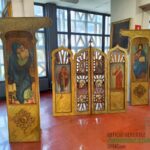
After the Mass, the participants visited the monumental exhibition, “Klisze pamięci. Labirynty” (Negatives of Memory: Labyrinths) in the basement of the Conventual Franciscan church. This work, created by Marian KOŁODZIEJ, one of the prisoners of the first transport (prisoner number 432), recounts the tragedy experienced in the extermination camps.
The commemoration then moved to Auschwitz, in front of the building of the old Polski Monopol Tytoniowy (Polish Tobacco Monopoly) – now the State University of Lesser Poland, named after Captain Witold PILECKI. It was here, on June 14, 1940, that SS officers (Nazi special squads) quarantined the prisoners of the first transport. The visiting delegations laid wreaths under a memorial plaque affixed to the school building in remembrance of the prisoners.
The last stop during the commemoration event was Auschwitz I, where, in front of Block 11, the participants sang the Polish national anthem, laying wreaths and lighting candles at the “Wall of Death,” in tribute to all the victims of World War II. The priests present also prayed inside the death cell of St. Maximilian M. KOLBE.
Finally, the Director of the Auschwitz-Birkenau State Museum, Dr. Piotr M. A. CYWIŃSKI, read letters sent to the participants by the President of the Polish Parliament, Szymon HOŁOWNIA, and the Minister of Culture and National Heritage, Hanna WRÓBLEWSKA.
Friar Jan M. SZEWEK