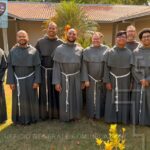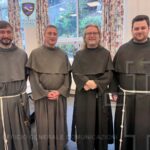




Eight hundred thirty-four! That is the number of habits that Conventual Franciscan Brother Augustine KELLY has made over almost fifty years of serving as a tailor for his community.
Brother Augustine, who ministers at the National Shrine of Maximilian Kolbe at Marytown in Libertyville, Illinois, USA, is part of an 800-year tradition of hand-sewing Franciscan religious habits.
Hand-sewing habits has largely fallen by the wayside in many religious communities, so much so that Brother Augustine calls it a dying art. Even in his own community, he is one of the only people in the U.S. that makes habits by hand.
Conventual friars around the world reach out to him, he said, adding, “We get requests from all over, especially friars passing through the country who stop by Marytown.”
Brother Augustine is sharing his knowledge with a friar from Kenya, now on sabbatical at Marytown, who plans to make habits for his fellow friars when he returns to Africa.
“No friar knows how to make habits in Africa. There isn’t. I have not seen,” said Franciscan Father Boniface Nzioki MUIA. “So I should be the first one. I think more friars need to know how to make them.”
Brother Augustine came to his role as tailor with some experience.
“I was always interested in sewing and costumes and theater stuff as a kid,” he said. “Then when I became an altar boy, I was quite fascinated with the vestments. I was kind of self-taught.”
When he entered the Order, he first taught high school. Then his Provincial asked if he could make habits. At the time, some religious women were making them for the community.
Brother Augustine always has other jobs in addition to tailoring, such as serving as sacristan.
“Tailoring was always my first love,” said Brother Augustine, who has lived at Marytown since 1999.
Franciscan habits are in the shape of the cross, which is a symbol of taking on Christ’s crucifixion. That hearkens back to the shape of clothing St. Francis donned after giving his life to God.
Francis’ original habit was very simple. That is not the case today.
“There are a lot of pieces to a habit,” Brother Augustine said. “It takes me about 10 hours to make a habit.”
Like many things in the life of a Franciscan, making a habit involves prayer.
“When I begin a habit, I personally offer up the work and the time for all the intentions of the friar I am sewing for,” Brother Augustine said. “It makes me feel like some of me goes with him in his ministry. And the friars know that.”
Women’s religious communities have made habits for the friars in the U.S. over the years, which is probably why not many friars have learned, Brother Augustine said.
“To me, there is something really nice about having it made by someone in your own community. And the friars tell me that,” he said.
While not required by his community, Brother Augustine wears his habit everywhere he goes.
“I’ve had very good experiences wearing the habit out in public. Sometimes people are just fascinated by it and they are drawn to you. And sometimes people will just say silly things to you because they don’t know what to say and they want to break the ice so they can talk,” he said.
Lots of people ask for prayers, and he stops and prays with them on the spot. And if some people stare or get angry at him because of what his habit represents, he doesn’t mind because there is a higher purpose at work.
“If for one brief moment someone’s mind is raised, not because of me, but because of what I represent, raised out of this world to maybe something a little spiritual, that’s a good thing.”
Religious habits still hold the special meaning that they did in the time of St. Francis.
“We are both body and soul. What we wear certainly represents something, it speaks to something. And St. Francis wanted to wear a poor tunic to be a poor man to reflect our Lord’s life that way. It’s very recognizable in today’s day-and-age that we belong to God.”
Excerpt from the ‘Chicago Catholic’
On-Line Newspaper of the Archdiocese
Joyce DURIGA, Editor