



“Lebanon is something more than a country: it is a message…” Thus wrote St. John Paul II in his Apostolic Letter To All the Bishops of the Catholic Church on the Situation in Lebanon, no. 6 (September 7, 1989).
Lebanon is a country characterized by a great diversity of religions and denominations. The main religious groups are Muslims (Sunni, Shiite, and Alawite), Christians (Maronite, Orthodox, Catholic, Armenian Apostolic and Armenian Catholic and Copts), as well as Druze. Each of these groups has its own traditions, practices, and institutions. Religion plays an important role in the daily life of the people of Lebanon, influencing their values, beliefs, and social behavior.
Yet, despite these religious differences, the country is known for its religious tolerance and mutual respect between the various religious groups. Many Lebanese identify both with their Lebanese nationality and their own religious community. It is precisely this unique blend of religions and national identity that makes Lebanon such a special place in the Middle East.
Unfortunately, wars and conflicts in recent years, combined with massive migration from Syria, have disrupted this harmony. Perhaps this is why Pope Leo XIV, during his visit to Lebanon in 2025, emphasized that we must unite our efforts so that Lebanon can return to its former glory: “Disarming our hearts is the only way to do this. Let us cast off the armor of our ethnic and political divisions, open our religious confessions to mutual encounter and reawaken in our hearts the dream of a united Lebanon. A Lebanon where peace and justice reign, where all recognize each other as brothers and sisters.” (Homily in Beirut, December 2, 2025).
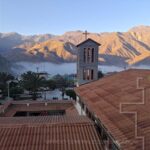
The Pope may have drawn these thoughts from the Maronite Catholic Patriarch of Antioch, Elias Boutros HOAYEK (1843-1931); I am sitting on a bench right next to his statue. He once wrote: “Both national feeling and religion make it an obligation for you to respect and love everybody whatever may be his belief. Reason leads you to fraternize with the person you live with under the same sky and on the same land.” On July 5, 2019, Pope Francis authorized the promulgation of the decree on the heroic virtues of Patriarch Elias, declaring him a Venerable Servant of God.
Thanks to the kindness and hospitality of the friars at the St. Antoine de Padoue Church and Friary in Sin El Fil (Beirut), I was able to spend some time in Lebanon during Lent and Easter. The members of this community are Friars Roger KOUYOUMDJI (Guardian), Jalil HADAYA, Felician TAMAŞ, Marian-Emanuel VÂTÂMÂNELU, Gheorge-Vasile TAMAŞ, and a postulant, Farid KHOURY. All of them, along with their collaborators and parishioners, showed me sincere kindness and support.
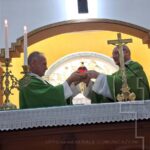
The location of the friary deserves special mention, as it is near the Maronite churches of Al Sayed, Mar Elias, Santa Rita, and the Coptic Orthodox Church. Thus, many Christians from other rites and denominations visit our church and participate in the liturgy. This is enhanced by the variety of languages used for prayer and hymns. As for the hymns, as far as I’m concerned, the liturgy could go on for two hours. I would only add that I was very impressed by the large number of faithful that attended the Holy Week and Easter liturgies. Apart from Assisi, it’s been a long time since I’ve seen people fill a church to the brim: some were even standing outside.
The friars here organize a weekly “soup kitchen for the poor with help from a group of faithful (no one asks about their religious affiliation!).” They work together to provide hot meals (two courses), and other food items, to more than 250 people. This is a concrete form of ecumenical and interreligious dialogue. I was delighted to be able to participate in this work, too.
During my stay, I got to visit some sacred sites around Beirut, such as the twenty-six-meter-high (eighty-five-foot) statue of Christ the Redeemer on Jabal Al-Salib (“Mountain of the Cross”), the Greek Melkite Basilica of St. Paul, the Marian shrine in Harissa (where Mary awaited Jesus during his stay in Tyre and Sidon), and the tomb of St. Mar Abda. After the Easter celebrations, Friar Felician, the postulant Farid, and I made a pilgrimage to the shrines of St. Charbel, St. Nimatullah Al-Hardini, Blessed Estefán Nehmé, and St. Rebecca (Rafqa) Ar-Rayès. We also visited the Monastery of St. Elijah. It is interesting to note how close these places are to one another. Describing the emotions that accompany such visits is always impossible, and so I leave them among my memories. They simply have to be experienced…
While in Lebanon, I also met with our confrere, the Most Reverend César ESSAYAN, OFM Conv., Vicar Apostolic of Beirut, Lebanon. We spoke about organizing an interreligious meeting with a prayer for peace in the context of the “Spirit of Assisi” initiative. Given the current situation in Lebanon, it is difficult to set a precise date, so we will remain in contact. During the Easter Vigil liturgy, we lit the Light of Assisi lamp, which will stay in the St. Antoine de Padoue Church.
We had an unexpected, but very joyful meeting with some Poor Clare sisters who had come to Lebanon:, namely, Sisters Gloria, Celina, Damiana, Lucia, and Maria Grazia. During the Chrism Mass on Holy Thursday, we prayed together at the nearby Saint-Joseph Church. The sisters assured us of their prayers for ecumenical and interreligious dialogue, and with support such as theirs, I no longer need to worry about the skepticism some people have about my ministry. The power of prayer, combined with openness to encounter and dialogue, can make possible what seems impossible to human eyes. The words that Pope Leo XIV spoke during his visit remain very significant: “Lebanon, stand up! Be a home of justice and fraternity! Be a prophetic sign of peace for the whole of the Levant!”
Friar Sławomir KLEIN
General Delegate for Ecumenism and Interreligious Dialogue (EDI)