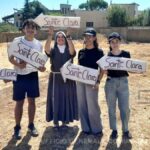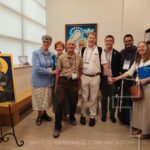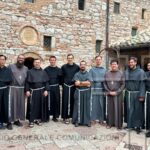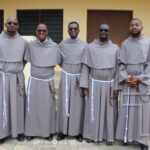




On Saturday, May 16, 2026, a Mass was celebrated in the Shrine Church of St. Anthony of Padua and Bl. Rafał Chyliński in Łódź-Łagiewniki, Poland., to commemorate the 300th anniversary of its consecration. His Eminence Cardinal Konrad KRAJEWSKI, Metropolitan Archbishop of Łódź, presided over the Mass and gave the homily. Numerous priests, sisters, and faithful attended the event; they were eager to give thanks together for the continual presence of the Conventual Franciscans here over the last three centuries.
Spirituality Made Tangible and the Oldest Monument in Łódź
At the beginning of the Mass, the local Pastor and Guardian of the friary, Friar Marek SYKUŁA, welcomed those present. He emphasized that today’s liturgy introduces the faithful to the mystery of the Lord’s Ascension, reminding them of our ultimate homeland in heaven. He pointed out that sacred art and architecture are human spirituality made tangible, while the soaring church towers constantly direct people’s thoughts toward what is most important.
In this context, he noted how three hundred years may seem modest compared to the monuments of Rome, but for Łódź itself it is an extraordinarily long period. In a city whose rapid development only dates back to the 19th century industrial revolution, the church in Łagiewniki remains a historical monument of exceptional value. Furthermore, it is the oldest building of its kind within the city’s current administrative boundaries and a living witness to continuity with the era of the First Polish Republic [the Polish–Lithuanian Commonwealth]. During the liturgy, prayers were offered for the builders, founders, and countless faithful and pilgrims who have visited this place over the centuries. Special remembrance was also given to those whose mortal remains repose within the church walls.
Three Centuries of History and Unwavering Witness
On May 16, 1726, exactly three hundred years ago, the Most Reverend Teodor POTOCKI, Archbishop of Gniezno, Primate of Poland, and the highest-ranking senator of the Republic of Two Peoples [the Polish–Lithuanian Commonwealth], solemnly consecrated the church in Łagiewniki, dedicating it to the worship of God. Anointing the walls and the altar, he entrusted the church to the protection of St. Anthony of Padua.
Cardinal KRAJEWSKI noted in his homily that St. Anthony is invoked in this place not only as the patron of lost things, but also as the intercessor for those who are spiritually lost and need to be led back to God. The Cardinal called attention to the difficult years of communism when the local people in Łagiewniki went in secret to the Conventual Franciscan Church to have their children baptized and to get married behind closed doors. In doing so, they often risked losing their jobs and facing repression from the authorities at the time.
From Stone Walls to the Living Tabernacle
Cardinal KRAJEWSKI emphasized the symbolic architecture of the church in Łagiewniki. People enter it from the shaded western side—bringing with them their weaknesses and confusion—in order to pray facing the east, which symbolizes the rising sun, that is, Christ Himself. While the physical church is indispensable for access to the sacraments and for being nourished by the Body of the Lord on the journey toward eternity, in the end, the people themselves form the living temple of God. The Cardinal made it clear that, after receiving Communion, the believer becomes a bearer of God—a living tabernacle, with whom Jesus wishes to go out beyond the church walls. The task of Christians is to carry this presence of God wherever their daily life takes place: in homes, workplaces, and the human peripheries of today.
A Personal Confession
In his welcoming address, the Pastor, Friar Marek, mentioned that Cardinal KRAJEWSKI had already visited the church privately a few days earlier. Cardinal KRAJEWSKI confirmed his close connection to this place, confessing that as a boy, he would come here in the winter on cross-country skis from nearby Arturówek. He also spoke with great devotion of Blessed Rafał Chyliński, a Conventual Franciscan whose mortal remains repose in the church in Łagiewniki. The Cardinal admitted that during his years of ministry in Rome he repeatedly entrusted difficult decisions to Blessed Rafał. Because of the friar’s extraordinary dedication to the sick and the poor, he affectionately referred to him as “the bishop of the poor.” Finally, he confessed that, just as in years past, he still enjoys escaping by bicycle from the bustle of central Łódź to the city’s oldest church. Within those walls steeped in prayer, he “recharges his spiritual batteries” to once again become a bearer of God.
The jubilee gathering became an excellent opportunity to pass on this material and spiritual heritage to a new generation of Łódź residents, while giving thanks for three centuries of the Franciscan message of Peace and All Good that continues to flow from the church in Łagiewniki.
Friar Maciej PIECZYNIA